|
I'm going to take a break from talking explicitly about teaching today to indulge the English teacher in me and share 10 books I read in 2020 I think others might enjoy. I should start by saying that reading for pleasure is one of my great joys. I read every night in bed — sometimes for 20 minutes, but often for 2-3 hours — and I also run an antiracist book club, which generally focuses on a single book each month (one exception to that — we broke "Stamped from the Beginning" into three months, as Kendi's phenomenal history of racism in America needed more than a single month to read and process). I read a lot over the course of each year, averaging somewhere between 125-150 books most years. I'm currently at 172 for 2020.
I am also the opposite of a book snob. Although I have specific tastes, for sure, I believe all reading is good reading. I love fantasy and science fiction, the genres I read most every year, but I also read a fair amount of mystery, romance and more general fiction. Here are some of the best books I read this year.
0 Comments
I created these five tips for good news media literacy this week for the upper school students at my school but wanted to share them here as well. Please feel free to share with your own students if you think they would be useful.
Here are five tips to ensure you are getting (and sharing) good information:
A version of this review originally published on JEA's Diversity, Equity and Inclusion blog. 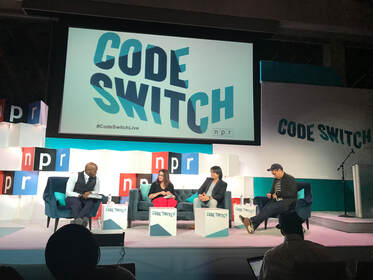 Gene Demby, NPR Code Switch co-host, records a live episode at the Skirball Center in Los Angeles on Oct. 6, 2017. The podcast gained national prominence in the wake of Black LIves Matter protests in 2020, when it shot up to #1 on Apple Podcasts and was featured in Oprah Magazine. Photo Credit: Kristin Taylor Gene Demby, NPR Code Switch co-host, records a live episode at the Skirball Center in Los Angeles on Oct. 6, 2017. The podcast gained national prominence in the wake of Black LIves Matter protests in 2020, when it shot up to #1 on Apple Podcasts and was featured in Oprah Magazine. Photo Credit: Kristin Taylor One of the key points in Zaretta Hammond's book Culturally Responsive Teaching and the Brain is that becoming a culturally responsive teacher means educating ourselves — immersing ourselves in diverse perspectives. One of my favorite ways to do this is to listen to podcasts hosted and produced by people too often marginalized in mainstream media.
NPR’s Code Switch started as a blog, which I read regularly, so I was absolutely thrilled when it morphed into a podcast four years ago. The very first episode, “Can we talk about Whiteness?” debuted May 31, 2016, and I’ve been a devoted listener ever since. I was thrilled when they rebranded this year: their new tagline (“Race. In Your Face”) reflects an unflinching willingness to ask those hard questions and talk about them openly. Co-hosts Gene Demby and Shereen Marisol Meraji blend stellar reporting with personal anecdotes; they have an easy camaraderie that gives the podcast warmth and humor, even when they are exploring some of the darkest and most troubling topics. They are experts, yet they freely admit questions about race and identity aren’t easily answered — one of the most common refrains on the show is “It’s complicated.” After I finished my journalism Master's degree in 2018, I took a break from this blog. There's plenty of teaching blogs out there, I thought — what might mine add? I don't know if I have an answer to that question, but more than a month into COVID-19 and safer-at-home orders, I think it's important we take time to make a record of what this time has been like in education. I would never dream of speaking for "all teachers" since our experiences are so profoundly different depending on where we live, what resources our schools and students have and what our personal situations are, but I can speak to my own life as a teacher and how teaching has changed for me. Since I'm finishing my 23rd year in education, I've been around the block a couple of times, but nothing (not even 9/11) compares to this.
Keywords: Camtasia, tutorials, multimedia, photo-editing After four years slowly working towards my Masters in Journalism while also teaching full time, this blog marks a milestone: my last assignment for my last grad class. (Well, except for the big research paper and professional project I'm finishing this summer, but that's Future!Kristin's problem.)
For this final project, I developed a tutorial using Camtasia, a screen-capturing video program on steroids. I'd often wondered how people made dynamic tutorials with fun animations — arrows pointing at content, speech bubbles clarifying context, screens zooming in to help the viewer focus — but I figured whatever program they were using was too complex for a full-time teacher to tackle. Camtasia may be a bit pricey for a longterm solution, but I was really impressed with how quickly I was able to pick it up during the free trial. You can see my first attempt at an animated tutorial later in this post. I see enormous potential for this as a teaching tool. |
About“And though she be but little, she is fierce!” -A Midsummer Night’s Dream Archives
December 2020
Categories
All
|
 RSS Feed